Which Esports Are Drawing Attention as Fall Begins?
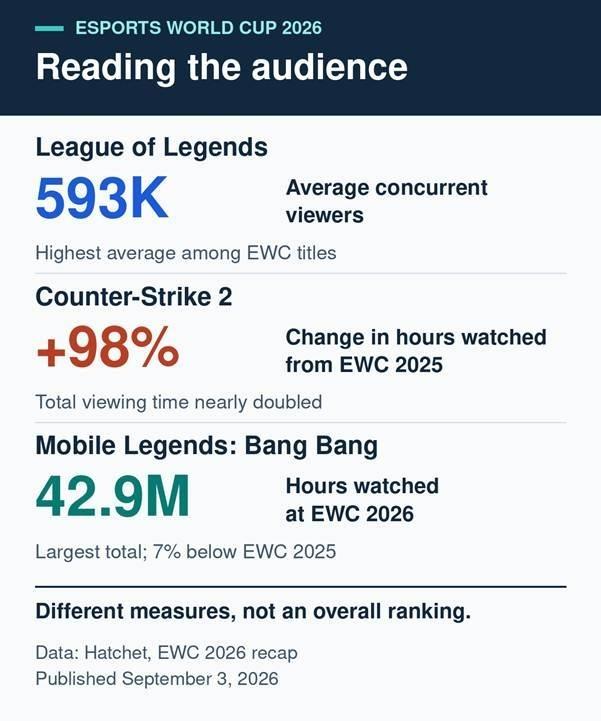
League of Legends, Counter-Strike 2, and Mobile Legends: Bang Bang enter fall 2026 with different signs of audience strength. Recent tournament reporting puts League ahead on average concurrent viewing at the Esports World Cup (EWC), shows a sharp increase in Counter-Strike’s viewing time there, and places Mobile Legends first for total hours watched. Those findings describe several active competitive scenes, with no single measure capturing the whole picture.
For those following the competitions, interest tends to center on particular teams and matches. Many viewers will be particularly interested in how recent performances shape expectations, which opponents present a difficult matchup, and whether a team carries its form into the next series. Following those questions connects one broadcast to another. Predictions give those expectations a definite form, while the matches themselves provide the results and the details behind them.
Hotspawn reported that T1’s series against G2 produced MSI 2026’s largest audience peak. Tech Times also recorded 2.32 million concurrent viewers for that matchup, excluding Chinese livestreaming platforms. The series outdrew the grand final. The same Tech Times report put T1’s July viewing time at 31.03 million hours across four tournaments and 17 matches, despite the team finishing the month without a title.
That focus on individual contests also informs fans’ match predictions. Assessing a matchup involves weighing team performances, making a choice, and comparing that judgment with the result. Free predictions through Hotspawn pickems cover CS2 and League of Legends, with weekly leaderboards comparing participants’ results. Following the matches gives those selections context: the teams’ decisions, execution, and responses to opponents explain how a series develops. A final score settles the prediction, but watching the contest reveals more about each team than the outcome alone.
League draws viewers across its broadcasts
The wider summer picture gives League another measure of audience strength. Hatchet’s September 3 Esports World Cup recap reported that the game averaged 593,000 viewers at the 2026 event, the highest average among its titles. That was up 32% from the previous edition.
Average concurrent viewing describes the mean audience present during the measured broadcast period. It gives a broader view of a competition than its busiest moment, accounting for the quieter stretches alongside its most watched matches, but it does not reveal whether the audience mostly consisted of the same individuals throughout.
The MSI figure has a narrower time frame: it records the largest simultaneous audience across tracked platforms, rather than the number of people who watched at any point during the series. That preserves the distinction between a broadcast’s busiest moment and its total reach.
T1’s July record adds a different perspective. Following a team involves a sequence of appearances, including matches before the final. Its viewing total accumulated across that schedule. The result shows that audience interest and trophies need separate consideration: a team’s competitive finish does not, by itself, describe the amount of attention its matches received.
For League players, there is also familiar detail to follow throughout a broadcast. Drafts establish team compositions, objective contests bring opposing plans together, and decisions during fights affect how those plans unfold. These provide subjects for discussion between matches, beyond the question of who won.
Counter-Strike nearly doubles EWC viewing time
In the same EWC report, Counter-Strike ranked second for total hours watched after a 98% increase over the 2025 edition. Its viewing time nearly doubled within this event, giving CS2 a clear sign of increased tournament attention heading into autumn.
Hours watched combines audience size with time spent viewing. A comparison between editions therefore needs to retain the event’s scope: this increase concerns EWC coverage, rather than every Counter-Strike competition held during the year. It also measures viewing activity, not a change in the game’s active player population.
The useful comparison with League concerns the type of strength being reported. League’s average captures the audience present across measured airtime. Counter-Strike’s increase shows how much its accumulated viewing changed between editions. These findings can sit alongside each other without being converted into a contest for the same ranking.
Mobile Legends leads EWC viewing time
Mobile Legends: Bang Bang led EWC viewing time with 42.9 million hours watched, according to Hatchet. That total was 7% below its previous edition. It retained first place despite the decrease, separating the question of audience scale from the direction of change.
Its position puts mobile competition firmly within the cross-game picture. A comparison limited to League and Counter-Strike would leave out the game that generated the event’s greatest total viewing time. The audience around professional gaming extends across the devices used to play it.
A large viewing total and a rapid increase describe different strengths. Growth alone does not establish which game already commands the most viewing time. Equally, a leading total does not establish that interest is increasing. Mobile Legends and Counter-Strike make that distinction concrete within the same event report.
The fall picture spans several scenes
These measurements describe broadcasts, rather than unique groups of fans. The same person can watch more than one game, and hours watched counts the time contributed across those viewing sessions. The figures do not show a transfer of players or viewers from one community to another.
League’s concurrent audience, Counter-Strike’s increased EWC viewing time, and Mobile Legends’ leading total give each a distinct place in the autumn outlook. Together, they show substantial attention around both PC and mobile competition. The next matches will add to that picture; the summer results already establish that competitive interest has several substantial centers.